What makes a life?
[HIT]
Are you singing “525,600 minutes! 525,000 journeys to plan.
525,600 minutes - how can you measure the life of a woman or man?”
I am here because of the compassion of Most Ven. Wonji Dharma and Most Ven. Myohye Doan, among countless others.
I just turned 60. Ven. Wonji once told me that in many Asian countries, this is an important age of change. There are 12 zodiac signs, paired with one of five elements (water, earth, wood, metal, fire). This is the year of the Wood Dragon. I was born in the year of the Wood Dragon. We’ve done a complete cycle of 12 times 5. This means that my life is over. Now I get a new life.
It makes a lot of sense to me. By this age, we will have accomplished most of what we will in our professional careers. If we had children, by this time we have raised them to be able to be self-sufficient. In short, we’ve paid our debt to society. It is at this age that historically many people would enter monasteries and refocus their lives on spiritual or other pursuits.
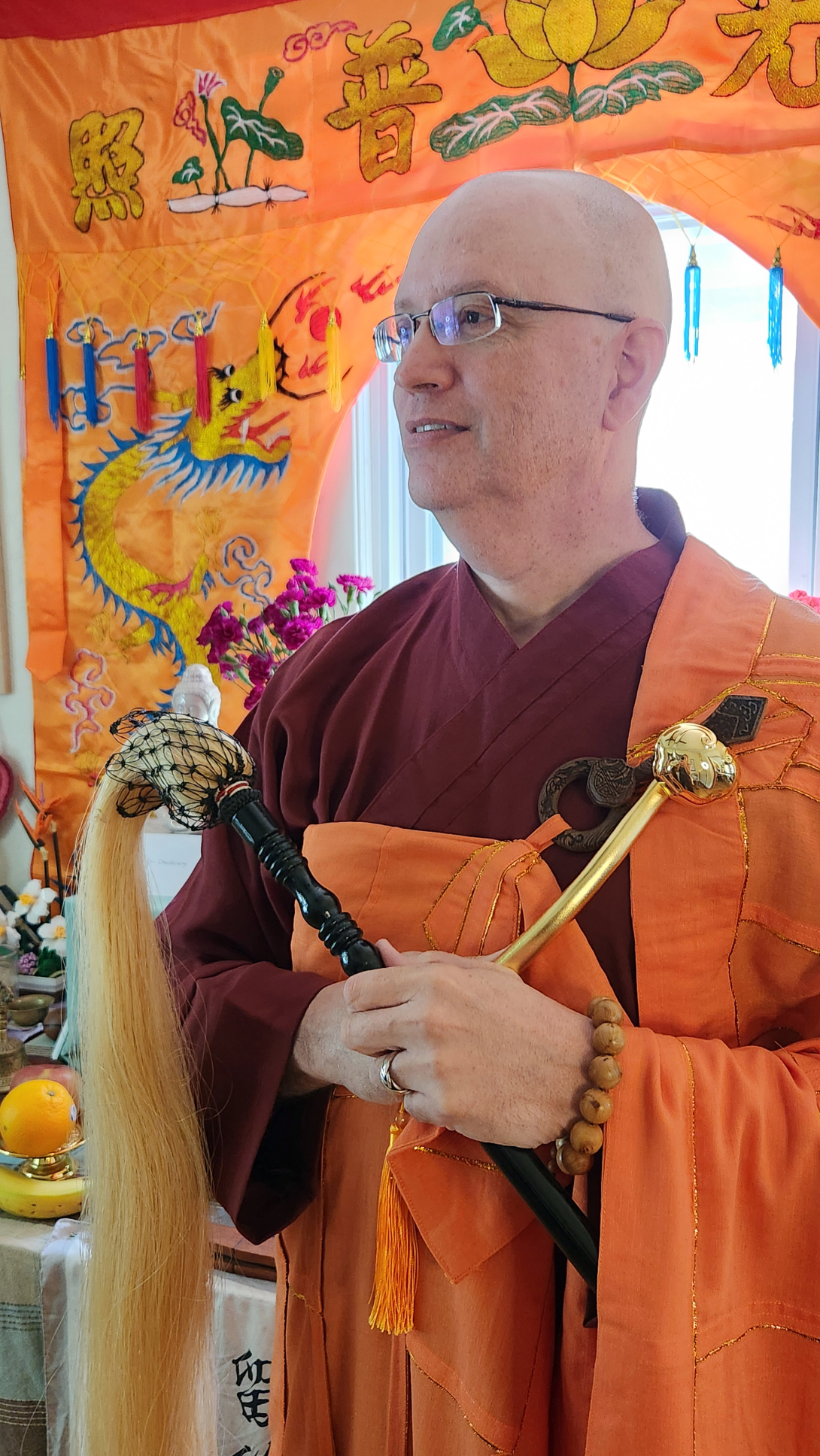
I’m taking this very seriously. I’ve been planning for it for the past 2 years, trying to wind down many of my projects. I can’t afford to quit my job, but I can reduce it in many ways to focus mostly on aspects that still interest me. With my new life, I plan to write more books, write and play more music, and spend more time in my role as a Buddhist monk.
I see this as an important milestone – an important change. This is a mistake.
I see this ceremony as a milestone. This is a mistake.
The Prayer of Samantabhadra opens with these lines:
Ho! All that appears and exists, saṃsara and nirvaṇa,
Has one ground, two paths and two forms of fruition,
The magical displays of awareness and unawareness.
I often use this as a Huatou, shortening it to: One ground, Two paths, Two results
One ground is reality as it is, inter-penetrating, interconnected, constantly shifting, without need.
As we open our eyes and contact reality we have two paths in front of us. One is to relax into not knowing, not needing to figure everything out, just being with reality as it unfolds. The other is to label, to think, to plan, and to strategize.
These two paths lead to very different results. When we relax into the situation as it is, we can move with it gracefully. When we try to figure it out, we pull ourselves out of reality and try to stand apart from it. One path leads to Nirvana, the other is laced with dukkha.
Ven. Wonji traced the core of our lineage practice back to Ch’an Master Dahui, who lived between about 1089 and 1163. He introduced the use of k'an-hua ch’an, the concentration on the huatou or key word to penetrate past its conventional meaning. Ven Wonji and I were studying a book of the letters of Dahui at the time of his passing. In it, there is a letter written to Judicial Commissioner Zhang Yangshu, who was the son of the Grand Mistress Ji Fazhen, one of at least three female Dharma heirs of Dahui. In the letter, he says:
Sentient beings are of an upside-down viewpoint—they “lose themselves and pursue things.” Absorbed in a few flavors of the five senses, they are pleased to receive immeasurable suffering.
Day by day, before they even open their eyes, before they get out of bed, when they are only half awake, their minds flutter about, scattered dissolutely in accordance with phantasmal thought. Even before the doing of good and bad actions has become manifest, from the time before they’ve even gotten out of bed, within their minds the heavens and the hells are “ready-made” (pp. 163-164).
One ground, two paths, two results.
Let’s look at this line by line.
“Sentient beings are of an upside-down viewpoint—they ‘lose themselves and pursue things.’” If this is upside-down, we should instead try to lose things and pursue ourselves. Dividing the world into things is the second path. We separate out objects, people, feelings, thoughts, past, future, and turn them into “things.” Once we are separated from any of these things, then our world becomes transactional. The “things” can do something to us or for us. We look at everything as if they are a threat or a cure, and if they are neither, then we don’t care about them.
We talk about a good or bad thing “happening to us,” but this is a mistake. You are the happening. Nothing happens “to” you.
If there is nothing separate and there are no things, how do we pursue the self? Once you’ve arrived at the understanding that good and bad are made by mind, and that there is no reason to continue to be concerned by them, Dahui says, “However, you also must not produce a notion of ‘matters of no concern.’ Merely turn the radiance backwards and do a reverse-illumination: The one who produces the notions [of good and bad and of separate things]—where does he come from?” (p. 163)
The next line is, “Absorbed in a few flavors of the five senses, they are pleased to receive immeasurable suffering.” Wow. Ain’t that the truth? We all know people who love to complain about things, even some politicians who love to say how bad everything is. Do those people seem happy? Oddly, and exactly as Dahui says, they seem pleased to continue complaining and suffering.
They are absorbed in just a few flavors of the five senses. We all have preferences. But when those preferences are held too tightly, we suffer. We want only some of the flavors, we don’t want others, and most we don’t even notice because we’re spending all of our time seeking some and avoiding others.
“Day by day, before they even open their eyes, before they get out of bed, when they are only half awake, their minds flutter about, scattered dissolutely in accordance with phantasmal thought.” I once heard a teacher trying to explain what before-thought mind is, saying it’s like just as you’re waking up in that moment before you begin thinking. You can feel the cool and warmth of the sheets, you can hear the birds, you can see that it’s light even without opening your eyes…. All of this is being in touch with reality. Even if something aches, there is no suffering, because it is before judgment. There is simply this awareness of aching. How long can we stay in that state before thinking takes over, and our world narrows and becomes stressful?
One ground, two paths, two results.
“Even before the doing of good and bad actions has become manifest, from the time before they’ve even gotten out of bed, within their minds the heavens and the hells are ‘ready-made.’”
Once we’ve divided the world into higher/lower, like/don’t like, good/bad, we’ve already created myriad heavens and hells that we go on to inhabit, and then blame the outside world for it.
Dahui goes on to say later in the letter, “The heavens and hells aren’t in another place—they are merely in the mind of the person on duty when he is half-awake, before he has gotten out of bed. They definitely don’t come from the outside” (p. 164).
One ground, two paths, two results.
We can test this and see for ourselves. When we relax back into the ground of being without making good and bad, without picking and choosing, just responding naturally to whatever is in front of us, we find that without worrying, nothing is left undone. When we instead look about and have preferences and desired outcomes, then we experience stress and discomfort. Even if we get what we wanted, why do you think that tradeoff is worth it?
Most Ven. Wonji Dharma wrote a poem titled, “We exist only for a moment.”
We exist only for a moment, in the vast unfolding, of the cosmic realm.
Yet we cling so tightly, to our ideas about life, and love and happiness.
It is these, that cause us to suffer, for incalculable kalpas, living out a cycle, over and over again.
Why is it so hard to just see?
We are only this, that we have now, there is no other….time, place, or, me.
Know that, you are perfect, just now, and need, no fixing, or improvement,
We just grab so strongly, to the idea of, a separate ‘I,’ that we lose, our true self, in the process, of the loss. (Circling a Black Hole)
One ground, two paths, two results.
So I ask you, What makes a life?
[HIT]
Put it all down.
I’m finished speaking. It’s almost time for lunch.